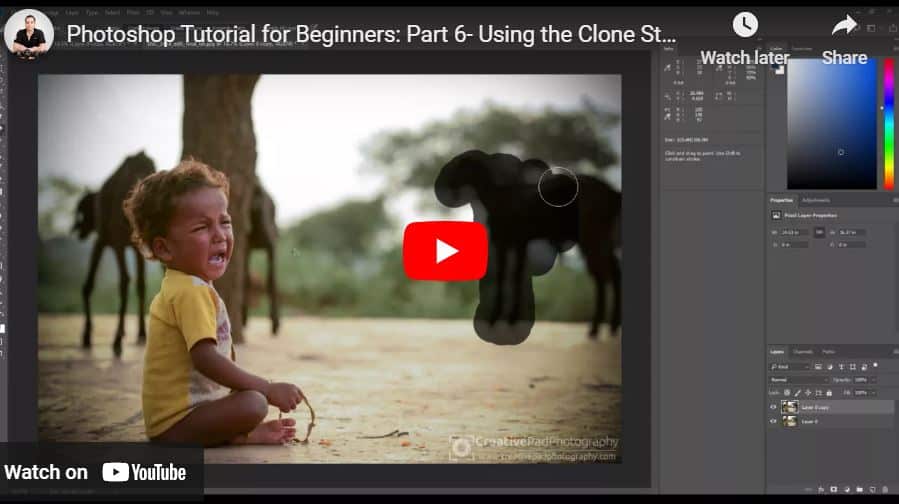
What Does the Clone Stamp Tool Do in Adobe Photoshop? – Beginners Tutorial
The Clone Stamp Tool in Photoshop lets you copy pixels from one part of an image to another, making it perfect for removing imperfections, duplicating objects, or blending elements seamlessly. It gives you full control over the edits, making it a powerful tool for retouching and restoration. In this beginner-friendly tutorial, we’ll show you what the Clone Stamp Tool does, how to use it, and some tips to get the best results. Let’s get started!
This video is from our Adobe Photoshop for Beginners Course.
Video Summary
The Clone Stamp Tool is a classic and versatile manual feature in Photoshop. Unlike automated tools (like Content-Aware or Spot Healing), the Clone Stamp gives you total control by allowing you to “sample” (copy) pixels from one area and “stamp” (paste) them onto another. It is equally effective for adding missing elements to a scene as it is for removing complex distractions.
Important Timestamps
- 1:42 – Patience vs. Automation: Why the Clone Stamp is preferred for manual control when automated tools fail.
- 2:45 – Adding Elements: A demonstration of adding clouds to an empty sky to improve composition.
- 3:08 – How to Sample: The “Alt/Option + Click” method to select the source area (the “target” cursor).
- 4:06 – Avoiding Repetition: Why you should sample multiple different areas to prevent a “copy-paste” look.
- 7:16 – Removing Animals: A challenging edit involving removing goats from a cluttered background.
- 11:04 – Working with Boundaries: Using the tool to clean up areas where different textures (grass, walls, and sky) meet.
- 11:37 – Opacity Control: Adjusting the brush opacity to 50% for a more subtle, gradual blending effect.
- 14:32 – Hardness Settings: Adjusting brush “Hardness” to match the sharp or soft edges of objects like trees.
- 15:17 – The “Hair” Challenge: Why removing objects touching fine details like hair requires advanced selection masks.